Twelve operating modes
Work, Legal, Health, Maintenance, Errands, Cooking & Food, Parent, Reset, Misc, Growth, Relationship, and Finance each carry their own purpose, boundary, timer rhythm, prompts, and definition of success.
It is a private planning and focus system for days that contain very different kinds of pressure. Instead of treating every responsibility as another item on one endless list, ModeMind gives each kind of work its own operating rules.
A client deliverable, a custody record, a meal, a bill, a conversation, and a moment of overwhelm can all be important. They should not all be approached with the same pace, emotional posture, timer, or measure of success.
ModeMind separates those contexts. Work Mode protects one professional deliverable. Reset Mode asks only for stabilization and one deliberate choice. Parent Mode protects presence and responsibility. Finance Mode contains money work inside a defined action. Every mode changes what the interface asks from you.
ModeMind is not designed to replace your calendar, project manager, therapist, doctor, attorney, or financial professional. It is the operating layer that helps you decide what kind of attention to bring, begin a contained action, and preserve the thread when you stop.
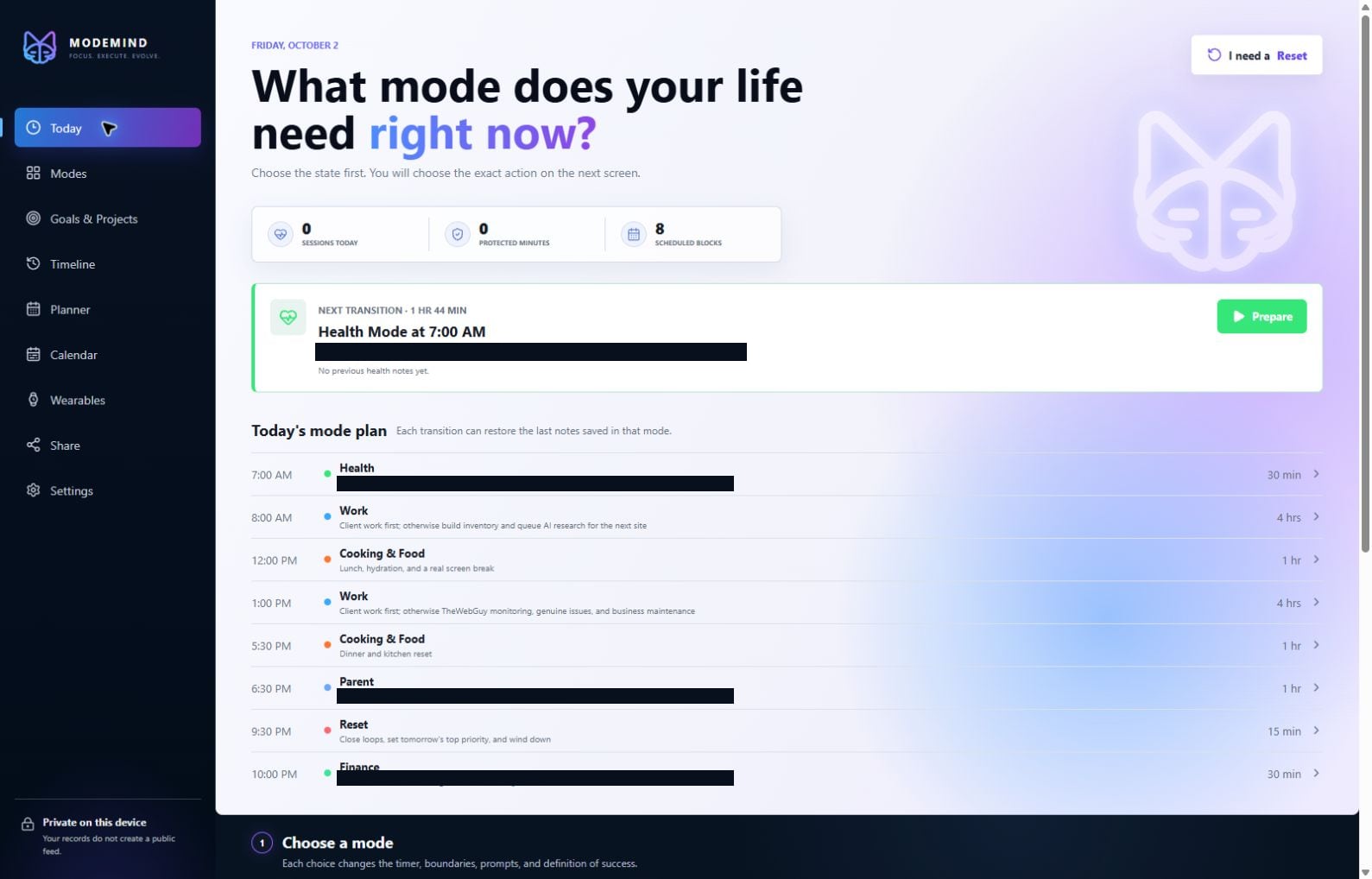
The features reinforce one another. Modes shape the session, goals supply direction, the planner prepares transitions, and closing notes preserve continuity.
Work, Legal, Health, Maintenance, Errands, Cooking & Food, Parent, Reset, Misc, Growth, Relationship, and Finance each carry their own purpose, boundary, timer rhythm, prompts, and definition of success.
Choose one visible next action, use a timer that fits the mode, take recovery when it is useful, and stop with a clear record of what moved.
Keep goals and projects open for as long as they matter. Give each one a current short-term subgoal and a concrete next action, then preserve completed subgoals as visible progress without falsely closing the parent.
Create one-time, weekly, alternating-week, or specific-date blocks. The calendar shows when those patterns actually occur and supports long, realistic days.
Closing notes, stopping points, saved next actions, upcoming-mode prompts, and private timeline entries help you leave one responsibility and return without reconstructing everything.
Schedule alerts can be descriptive or discreet by mode. Sensitive contexts can stay generic while practical transitions still arrive at the right time.
Dot can prepare additions and edits for your review. Private commands are encrypted, expire automatically, and do not take effect until you approve them in ModeMind.
Sessions, notes, comments, attachments, and Legal details stay out of Dot’s readable view. Only limited schedule and non-Legal direction data is shared when needed for accurate help.
A mode changes more than the label on a timer. It defines the purpose of the session, the state you are trying to create, the time pattern, the rule that protects the work, and what counts as enough.
Produce income and move one professional deliverable forward.
Advance one factual legal, custody, evidence, or court matter.
Support the body and mind well enough to function.
Keep home, paperwork, and life infrastructure from quietly falling apart.
Handle travel, pickups, returns, appointments, and outside coordination.
Feed yourself or the household without carrying the decision all day.
Protect presence, responsibility, advocacy, and memories with your children.
Stabilize when you are overwhelmed, frozen, angry, scattered, or overloaded.
Contain legitimate one-off obligations that truly do not fit elsewhere.
Build future capability, independence, and possibility beyond survival.
Protect deliberate connection, appreciation, communication, and repair.
Create awareness and control around money through one contained action.
Work, caregiving, appointments, health, household upkeep, money, relationships, and difficult administrative situations do not require the same state of mind.
ModeMind reduces the distance between seeing an obligation and taking the first contained step.
A mode can absorb a changed priority without forcing the whole day to be rebuilt or treated as a failure.
The system preserves where you stopped and what should happen next, which makes returning less expensive.
ModeMind can sit beside Asana, a calendar, paper notes, or another system. It holds active direction and session continuity rather than duplicating every task.
Dot can help organize and update ModeMind while the final decision stays on the user’s device.
ModeMind does not promise motivation on demand. It makes the next useful state and action easier to see, safer to begin, and easier to resume.
A flat list assumes the same version of you is available for every item. ModeMind first chooses the operating state, then narrows the action to fit it.
Each mode defines what enough looks like. The goal is controlled movement, not finishing an entire category of life in one sitting.
A visible session length makes starting safer and prevents Work, Legal, Finance, or Maintenance from silently consuming the whole day.
Capturing the stopping point and next action lowers the mental cost of leaving now and returning later.
Repeating blocks, specific dates, interruptions, and priority changes are expected. The planner supports patterns without pretending the week is rigid.
When sensitive records stay private and remote changes require review, ModeMind can hold useful context without demanding blind trust.
Choose the right mode, move one piece forward, leave a usable thread, and let that be enough for this session.